Small Village House with River Redwork
A Quiet, Handcrafted Vibe That Fits Real Projects
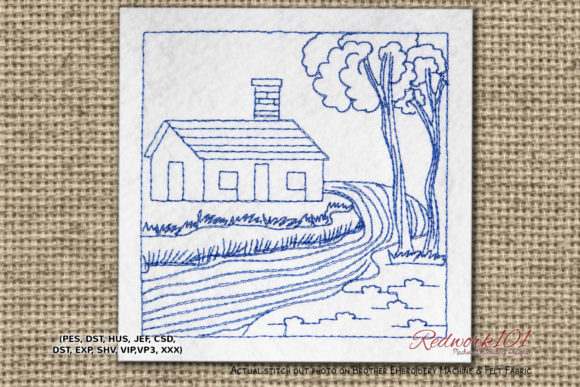
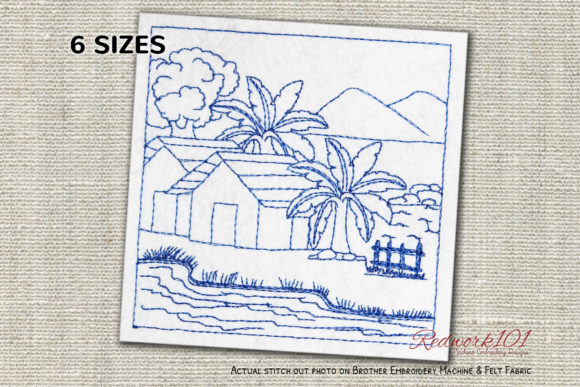
As an embroidery designer who’s stitched thousands of customer orders—from boutique aprons to Etsy baby blankets—I opened Small Village House with River Redwork expecting charm, not complexity. And it delivered. This isn’t a busy cityscape or a hyper-detailed architectural rendering—it’s a gentle, hand-drawn redwork motif: a modest cottage beside a winding river, rendered in clean running and satin stitches. The mood is nostalgic, unhurried, and deeply tactile—like something you’d find on a linen tea towel in a countryside kitchen or stitched onto a baby’s organic cotton onesie.
What It Naturally Wants to Be Embroidered On
Small Village House with River Redwork thrives on simplicity and surface texture. It’s sized and structured for smaller hoop work—think 4x4 or 5x7 inches—making it ideal for items where subtlety matters more than scale: pillow covers, cap brims, pocket accents on denim jackets, and the front panel of lightweight tote bags. I tested it on a natural linen kitchen towel and a medium-weight cotton sweatshirt, and both held the stitch definition beautifully. The design doesn’t rely on dense fill areas, so it breathes well on woven fabrics and avoids stiffness—a real win for baby blankets or nursery decor where softness is non-negotiable.
How It Performs Across Common Commercial Uses
- Custom apparel: Works cleanly on crewnecks and raglan sleeves when placed on flat panels (not curved shoulders). Avoid high-stretch knits unless paired with cutaway + tear-away stabilizer combo.
- Tote bag design: A standout choice—especially on natural canvas or unbleached cotton. The redwork style reads clearly at arm’s length without competing with print or dye variations.
- Embroidered patch: Yes—but only if you’re stitching it as a sew-on (not iron-on). The outer box stitch shown in the preview is optional, and I recommend omitting it unless your patch needs framing for visual balance on dark fabric.
- Baby items & nursery decor: Its low stitch density and lack of tiny lettering make it wash-safe and safe for sensitive skin. No risk of snagging or stiffening after repeated laundering.
- Caps & curved surfaces: Use caution. The house silhouette has subtle angles that can distort on low-profile caps. Best reserved for structured front panels—not curved bill edges.
- Printable mockup & digital product listings: Because it’s from the Cities category but feels distinctly pastoral, it adds unexpected warmth to digital embroidery bundles—especially when grouped with seasonal or rustic-themed design assets.
Practical Notes Every Designer Should Check Before Stitching
This isn’t a plug-and-play file for every fabric or machine. Here’s what I verified before using Small Village House with River Redwork on a live order:
- Test on scrap fabric first—especially if pairing with textured weaves (like burlap-look linens) or dark backgrounds. Redwork relies on thread color contrast; light red or brick tones pop best on cream, oat, or charcoal—not navy or black.
- Review stitch density carefully. While not overly dense, the river line uses fine running stitches that may need slower machine speed on delicate fabrics like chambray or voile.
- Confirm hoop size compatibility. The design fits comfortably in a 4x4 hoop, but check the actual file dimensions listed on the Creative Fabrica page—some versions include optional borders or alternate layouts.
- Compare light vs. dark fabric mockups. On dark fabric, consider switching to a slightly brighter red or burnt orange thread to maintain legibility of the river and roof lines.
- Use appropriate stabilizer. For towels and napkins: medium-weight tear-away. For stretchy sweatshirts: cutaway + light tear-away topping. Skip heavy fusible unless absolutely necessary—the design’s charm lies in its lightness.
- Inspect small details post-stitch. The chimney and window frame are minimal but intentional. If they blur or skip, re-hoop and reduce top tension slightly.
- Verify licensing terms on Creative Fabrica. As a commercial embroidery file, confirm whether resale of finished products is permitted—and whether digitized derivatives (e.g., resized versions or color variants) fall under the same license.
How It Elevates Your Handmade Product—Without Overpromising
Small Village House with River Redwork won’t shout. But it builds trust quietly. When customers see this on a handmade apron or baby blanket, they read intention—not automation. That matters for Etsy sellers and craft fair vendors: buyers associate thoughtful, restrained embroidery with care and authenticity. It also photographs beautifully—no glare, no shadow distortion—so your product images feel warm and cohesive, even without professional lighting. For boutique merchandise or personalized gifts, it adds narrative weight: “This isn’t just a towel—it’s a moment, stitched.”
Final Thought: Worth Adding to Your Design Library?
Yes—if you serve customers who value understated storytelling over trend-driven graphics. Small Village House with River Redwork fills a quiet but growing niche: modern heirloom embroidery. It’s not flashy, but it’s versatile across categories—apparel, home goods, baby items—and scales gracefully into both physical and digital product offerings. Just remember: its strength lies in restraint. Let the redwork breathe. Choose thread colors deliberately. Stabilize thoughtfully. And always test before committing to a client’s favorite linen shirt or heirloom quilt square. Done right, Small Village House with River Redwork becomes less of a design—and more of a signature.